| Episodes: 1 | Score: 8.2 (1734)
Updated every at | Status: Finished Airing
Type: Movie
Producers:Pony Canyon | TBS | Asmik Ace | GKIDS
Synopsis
Togashi is born to run. As a kid, he is naturally gifted and wins every 100-meter race without effort. But in sixth grade, he meets Komiya, a transfer student who is full of determination but lacks technique. In teaching him, Togashi gives Komiya a new purpose: to win no matter what. Years pass by, Togashi and Komiya meet again as rivals on the track and reveal their true selves. (Source: Annecy Festival)
Voice Actors

Sometani, Shouta

Yuuki, Aoi

Matsuzaka, Toori

Tanezaki, Atsumi
News

07/17/2025, 03:44 PM
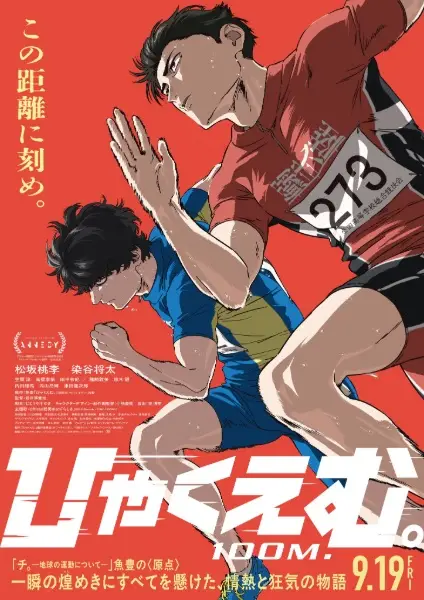
The official website of the Hyakuemu. (100 Meters) movie announced additional staff, a key visual (pictured), trailer, and the theme song on Friday. The anime movie ...

06/25/2025, 07:31 AM
The official website of the Hyakuemu. (100M.) movie announced additional cast members on Wednesday. The anime movie adapting Uoto's sports drama manga will pre...

06/13/2025, 08:30 PM
The official website of the Hyakuemu. (100M.) movie announced two supporting cast on Friday. The anime movie adapting Uoto's sports drama manga will premiere in...

04/20/2025, 07:11 PM
Asmik Ace opened an official website for the Hyakuemu. (100M.) movie on Monday, revealing the lead cast, additional staff, a teaser visual (pictured), and trailer. T...
![Q2 2025 Anime & Manga Licenses [Update 6/6]](/_next/image?url=https%3A%2F%2Fcdn.myanimelist.net%2Fs%2Fcommon%2Fuploaded_files%2F1742946271-8e5b7b5e176b17a57174dd310cfedf3c.jpeg%3Fs%3D373042b54948228a9e65bb24e9e75317&w=640&q=75)
03/25/2025, 04:45 PM
In this thread, you'll find a comprehensive list of anime and manga licensed in the third quarter (Apr-Jun) of 2025. Spring 2025 anime which were licensed befor...

05/23/2024, 06:56 PM
The Annecy Work in Progress event at the Annecy International Animation Film Festival announced an anime movie adaptation of Uoto's Hyakuemu. manga on Thursday...
Reviews
JettGroove
Why do we run? But more importantly, why do we live? Hyakuemu is not just your average sports anime about rivalry, overcoming challenges and breaking records. To be more precise, its story has some of these elements, because one of the topics is still high-performance sport, but the emphasis is completely different, much more philosophical than just “train more, become stronger and win”. It explores what exactly compels a person to run or engage in any other activity, and even though the movie isn’t tagged as psychological, since the dialogues are largely permeated with thoughts on escapism and existentialism, it actually is! Now, regarding the characters, thereare five runners with the same goal, but completely different views on how and why they should achieve it. Watching them interact with each other is absolutely captivating, very easy to connect on an emotional level. However, from my perspective, there is a small drawback: we don't get enough insight into Komiya’s past to get a better grasp of his outlook on life. After all, he is one of the main characters, wish they had given him slightly more screen time. And yet, this problem originates in the source material itself, not the adaptation. What really took me by surprise was the high-fidelity animation. I was apprehensive that the rotoscoping technique would be used too often and was very skeptical about its quality. Disliked it a lot in other anime before, usually rotoscoped sequences lack detail and frames, unlike traditional 2D. In Hyakuemu it looks almost perfect and is justified by the fact that animators traced the movements of professional sprinters, which added extra layer of realism. So... you're probably asking why “almost perfect”? Well, in fact there was a low FPS animation sequence for about 30 seconds during the relay race and it looked choppy. Another weird decision is the scene with a static shot of the sky, with the accompanying noise of the race in the background. While this moment isn’t important to the story, it still looks like a budget savings. One of the key aspects that I definitely have to mention is the excellent sound direction, staff showed meticulous attention to the ambient sounds. The clickety-clack of the train wheels, the rain, the runners breathing, the stomping of sneakers, the starter pistol shot, and the clang of starting blocks – all of these authentic sound effects make the scenes more tense and immersive. The main musical theme is also magnificent; trumpets are always a great choice, ideally suited for the sports genre. There's even an additional extended version of the track, specifically created for your own workouts. In conclusion, it breaks my heart that Hyakuemu isn't getting the recognition and hype it deserves. I highly recommend everyone to watch this anime; even if you're not into sports, it's worth it anyway! All the minor flaws I described do not detract from the core message and the overall enjoyment of this work of art.
AceAizawa
This is my honest review after watching it, but I'm still in the process of understanding it more deeply from a narrative perspective. I even want to rewatch it or read the manga version. Most people probably watched Hyakuemu because they were moved by Uoto-sensei's previous work, Chi: Chikyuu no Undou ni Tsuite. Yes! That includes me. This time, the theme is very different, but one thing remains the same: it's a story about people who dedicate themselves completely to a single goal. Just as a seiyuu is judged by their ability to portray different characters, a writer can also be measured by how they explore contrasting themes. And...How does Uoto-sensei explore the sports genre? And what is the quality of the anime from a cinematographic perspective? Here is my discussion. 1. Animation & Visuals The character design, which bears many similarities to Chi, combined with the rotoscope technique used in this film, immediately caught my attention. The movements feel fluid, human, and realistic. Every footstep, every swing of the arm, even the facial expressions, seem to carry the weight of unspoken feelings. As a result, it feels like watching real people running, not anime characters made to "look cool." There is one minor flaw: in one scene where Togashi is walking and having a light conversation with his clubmate, the background movement is very choppy and distracting. It's very uncomfortable on the eyes, even though it's very minor and not in a scene that demands focus. 2. Music & Sound Design The opening music, especially the trumpet part, immediately pumps your adrenaline. But as the film progresses, what really stands out champion are the sound effects: the sound of shoes hitting the ground, the impact on the starting block, everything is clear and crisp. Especially during the long take rain scene where Togashi vs. Kojima, the sound... Ugh... It was enough to make my hair stand on end. 3. Story Hyakuemu is not a film that tells its story through major conflicts or tear-jerking drama. The story flows like a 100-meter track: fast, dense, but full of points that mark a long journey using time skips. It's more about the ups and downs of Togashi's life, a talented runner whose life changed after meeting Komiya. And interestingly, this film often plays with the audience's expectations. It might be frustrating for fans of typical sports anime (I don't really like sports anime, I only like Blue Lock, Kuroko, and Eyeshield). For example, as a child, Komiya had broken shoes and refused to replace them. Togashi (and I too) immediately thought: "Okay, this must be because he's poor." Turns out, no. Komiya just wanted to keep wearing the shoes that had been with him through his struggles. In the next scene when they are older, without any mention through dialogue, the visuals show that Komiya always wears the same shoes he uses for practice. 4. Themes Hyakuemu is the most "silent" film about sports. The theme of Talent vs. Effort is presented not with shouts of "let's go!" or "one more time!", but with a painful silence. Every character here runs not just to win. Everyone knows they want to win, and that's something they will always crave. This is where the characters experience their own problems about the meaning of victory, the process, and the doubts... what is that victory for? And that's where the meaning becomes broader: the 100-meter run in this film transforms into a metaphor for life; short, intense, but full of existential burdens. 5. Characterization & Relationships The rivalry between Togashi and Komiya isn't about who is faster, but about who is more honest with themselves. Komiya appears like a typical shounen protagonist representing hard work and effort, but he has a depth rarely found in sports anime characters. Meanwhile, Togashi is much more complex; his talent is great, but that's precisely what makes him lost. One of my favorites is the character Kaido (who looks like Novak), the "number two runner" who always lives in the shadow of others. His inner monologue during the semi-final match was... bitterly poignant. He knows the reality is he will never be number one. He's the type who is self-aware and thinks most realistically. BUT!!! In that moment, he realizes, if the reality is that he will lose and he chooses to run (a way of running away from the problem), why not choose to run beyond that reality itself?! That scene made me feel deeply struck. Conclusion Hyakuemu is a sports anime aimed more for contemplation than for cheering due to its excitement, but that doesn't mean it isn't exciting. On the contrary, the immersive cinematography of the running scenes can make the audience feel pumped along with it. It's about people who run for victory, while simultaneously understanding the meaning of their own steps. A film that is simple on the surface, but deep underneath, like a 100-meter track that looks short, but actually holds an entire life's journey.
KaiKEKz
One of the peak Absurdist anime movies, if you're into philosophy and maybe reading the books of Albert Camus about Absurdism, you might notice that there are so many philosophical references from the Absurdist view. Not only that, the cinematography is so unique and kinda interesting to see. I feel that the Rotoscope in some scenes contains some symbolism. "If life lasts only 10 seconds, why run?" "Because in those 10 seconds, I become myself" This is pure ecstasy of absurdist philosophy. It's not just a simple rivalry anime. It's so philosophical, realistic, eye-opening, and it's so dang deep! What a piece of art! Well done, Uoto Sensei!
RioTey2004
If you are familiar with the author's previous work, Orb: On the Movements of the Earth, you would know that he is very much interested in storytelling that is geared towards existentialism and philosophy. 100 meters is a definite must watch if you love Orb and sports anime in general. In a lot of ways, 100 meters isn't just your typical underdog sports movie, it is a story about the how life will overtake you and you will learn to cope and do better. 100 meters race is a simple metaphor of "life is short, experiencing the moment while it lasts." The film is very wiseto put different characters on screen and build their character arc and how they deal with loss on the race track, especially our MC, Togashi, and it is very beautiful to see his career rise and fall, and rise again. The attention to detail is immaculate, just like orb, every characters in the film feels like real humans and don't just act like anime characters, the way they talk and act for someone of their age, it is wonderful to see. This is something that I didn't expect, the animation is absolutely spectacular, they have incorporated a great blend of rotoscoping and hand drawn animation. There is a scene where a character breaks down crying, and it is the most heartbreaking and beautiful scene in the film done entirely by rotoscoping. The music for the most part is very strong, I find myself on the edge of my seat on every single dash race. Do yourself a favor and see this on the big screen, this is the type of story that we just don't get to see anymore, I think it's great and I want more anime like this. It is one of the best films that you've never heard of.
RevloKrOne
Watching Hyakueme made me realize that I haven’t truly given my best effort at anything in my life—not even once. It felt like pure fate that my friends booked tickets for this movie. What began as a casual outing turned into one of the best anime movies I’ve ever watched. As someone who ran track and field in elementary school in China, every year we had a sports day to see which class in each grade would come out on top. I was always in charge of the 200m, 400m, and the men’s 4x100m relay for my class—and I always placed first. But one year, around fourthgrade, another kid won the 400m with ease while I struggled to keep up. I can’t quite remember how I felt, but I know it wasn’t great. That season, my parents started scheduling basketball practice for me—just for exercise, they said. But by the next year, something had changed. In fifth grade, I ran the 400m again, and this time, I won easily. I can still remember that day vividly. The track was a 200m oval, and the other kid stayed ahead for the first lap. I kept up behind him, and at the start of the second lap, I felt him slow down. I shifted to the second lane, passed him, and sprinted like my life depended on it—“like a deer,” as my parents described it. At that moment, nothing else in the world mattered; everything around me blurred, and there was no one left in front of me. I was the winner, again. When I was thirteen, my family moved to Canada. Before that, I had started learning tennis because, after a field trip to Canada, my dad told me that people there played tennis more often than badminton. Looking back, I might have had some natural talent. My coach even invited me to join the junior professional team alongside his son. After a few months, I could finally keep up during rallies, and a year later, I managed to beat another player to move up from last place on the team. Over the next two years, I joined tournaments across the province and earned a respectable ranking. But unlike the kids training daily after school, I only practiced on weekends. By sixteen, I could beat about half the players on the team, but I had never once defeated my coach’s son—not even in practice matches. Then, in one tournament, fate placed us against each other in the finals. I knew I was likely going to lose. Like Kaido in Hyakueme, I had accepted reality. But I decided to play as if it were the last match of my life. I tricked myself into believing I was already the winner, and somehow, that belief changed everything. I played freely, fearlessly, and for the first time—I won. Looking back, I think I might have pulled him into my imaginary world. He felt pressured, dominated, afraid of losing—and that imagined confidence became real. A year later, though, I retired due to a shoulder injury. After watching Hyakueme, I couldn’t help but wonder: what if I had truly devoted myself to recovery? What if I had ever given my absolute best, like Togashi did? Maybe a miracle would have happened for me, too. Throughout my life, I’ve felt regret, but never reconciliation. Perhaps that’s why I never tried my best at anything. It was easier to make excuses—to tell myself that I didn’t fail, I just didn’t try hard enough. But this film helped me realize something deeper: even if the results don’t go your way, peace comes from knowing you gave everything you had. Hyakueme reminded me that effort is not about winning or losing—it’s about honesty with yourself. Thank you for reading and for sharing some of my memories with me. For those who have already given their best, I respect your courage and spirit, and I wish you the best of luck in the future. And for those like me, who have coasted on talent and still achieved decent results—remember, talent is on your side, but never rely on it. One day, an ordinary warrior will challenge you, and you’ll witness the power of sheer will.
thewaflwizard
I want to say first and foremost that, for some reason, I exited the theatres with a great sense of motivation to get things done and to change my routine. If you get attached easily to a plot, like I did, I am certain that you will also feel this rush. Hyakuemu is a great tale of growth and perspective of multiple runners, each aiming for gold and the records when young, then discovering what it is that they truly want. The story focuses on three arcs (childhood, teenagehood, and adulthood), each with its own charm that I believe the viewer can associate themselves with. Despitelearning a lesson during one period, there are new ones that appear in the following arcs; these are more the focus of the plot than the actual running, although they are animated in an UNFORGETTABLE manner. Seriously, for such an unknown new movie in the anime sphere, it is **impressive** how good some of the running sequences were (especially a certain scene in the rain). This was some high-octane action, not shounen style, but thrilling and making one's heart pump with each step that the characters take on the track. As often as they appeared to run, it did not feel repetitive, accompanied by fanfares in Tsutsumi's score (both metaphorically and literally). And, something that felt like a breath of fresh air was that there really weren't any antagonists. I was rooting for every one of them to succeed to a certain degree; just like in any discipline, it is such an opportunity to showcase all of the efforts that one puts into their craft. And you feel for the main character when he realizes how ruthless this sport/passion is, training for decades for a spotlight that shines on you for a little over ten seconds. The movie is very dialogue-based, much like the author's other anime adaptation, Orb. I only wish that by the end, it had tried to keep us more engaged in the dialogue, as by then, it began to feel a bit hard to cling to. I believe that this would've been helped if the score had been much more present in those scenes, to support the speeches and to make us more attached to them. That is mainly the only problem among with a slightly anticlimactic ending that suggests to the viewer to interpret and reflect on what happens (but if you have yet to watch the movie, I'll leave that up to you :)) Highly recommend the watch for anyone who is on the fence. You'll at least be treated to a visual spectacle (Also my god did Komiya's high school hair style look good😂)
willster88
Hyakuemu, or 100 Meters, is a movie that is about passion. It covers a variety of characters with the full spectrum of motivations as they strive for glory within the short 10-second race they've bet their whole lives on, and in doing so, it really gets at the heart of competition and drive, and how it can embolden you and destroy you depending on what you make of it. It's a truly beautiful theme, but one that the movie sometimes struggles to fully encapsulate within its less than 2-hour runtime. ----- Story ----- *** This section has mild spoilers about themes and the broad strokes of afew characters' roles *** The story mainly follows Togashi, who at the beginning is just a kid who can run 100 meters very fast. But as the movie goes on, we see how his drive for running takes him through his youth and into his adulthood, and how that shapes the various stages of his life. His journey goes through many stages, as we see him at various stages suffer crushing defeats, see his progress stall, lose sight of his goals, but also overestimate his ability to win, and hold an unshakeable belief in his own victory. He experiences the full set of ups and downs, faces many tough roads, and ultimately realizes what the reason for his running is, which allows him to finally push himself to his limit. His story showcases the full spectrum of living a life that's built around pursuing a passion, and it makes him feel particularly relatable and real. His main rival, as seen at the start of the film, is Komiya. Komiya is a kid who starts with nothing, and so his life path is very different. He is much more willing to be singularly driven, never losing sight of his goal, and Togashi is the one who points him down the path he will eventually spend the whole movie chasing: to be the best at the 100-meter race. His story is very different; partially because he's in focus less and partially because he's more headstrong and more able to be singularly focused, we do not see him fluctuate. He continues to improve, continues to climb the ladder, and is continually a powerful competitor throughout the whole movie. Due to his drive, he constantly forces Togashi to re-evaluate his life and his purpose every time they bump into each other, and as such, he's a strong driving force for the plot in the movie and does a good job representing a very different side to pursuing passions. Along with the main 2 members come a large cast of characters who all showcase something different about passions, about competition, and about running - from Togashi's high school teammates, who can't help but love running despite not being particularly talented at it, to Kaido, who still feels the drive to win despite being past his prime in age, to Zaitsu, who is the record-setting goalpost for most of the characters in the series and experiences the problem of being alone at the top. The cast is diverse and captures feelings that both people who are professionals in a competitive field/sport and people who just have passions they love to pursue will relate to. The movie is divided into 3 major arcs following 3 major eras of Togashi's life: first, Togashi's elementary school days, where he first meets Komiya; then, Togashi's high school career, where he re-ignites his passion for running; and then finally, Togashi's adult life, where we see him try to continue pursuing running even after he's out of school. Each of these arcs is powerful and features something different about running that is important to Togashi's life. And throughout each of these arcs, all of the characters we meet teach us something about finding meaning through passion. But, given that the movie is less than 2 hours, this means that each arc doesn't have as much time as they feel like they need to cover everything they want to. Especially considering the adult arc is about half the movie, each of the arcs that cover Togashi's youth is quite compressed. As a result, a lot of the characterization comes very quickly or is even implied. For example, we are never explicitly given any backstory to Komiya's life, and we're forced to piece it together from tidbits we hear about him in the 2 youth arcs. In addition, the characters from Togashi's high school life are relevant for such a short period of time that, despite their reasons for running and their motivations to improve being really interesting, you never get the satisfaction of seeing how their stories resolve or how they end up. ----- Art ----- The art in 100 Meters is stunning. If you've seen the major other adaptation of this author's work, "Orb: On The Movements Of The Earth", you know that this author's art style is pretty unique, and the movie captures that perfectly. The characters and the environment feel much more gritty and realistic than in the typical anime art style, and given that this takes place in venues that are familiar to many of us, it feels very fitting as well. Also, the movie takes a lot of care in making every character not stay still in most scenes, especially when they are in focus. When characters are saying something important or are taking actions that are meant to be paid attention to, they are constantly moving, and it makes the characters feel much more real. In addition, the movie does an amazing job of using visual distortion to show emotions. When characters are feeling strong emotion, their point of view warps to match. For example, when characters feel pain in a body part, that body part starts warping; when characters start feeling anxious, their point of view starts becoming distorted. It really does a great job of emphasizing all the emotions the characters feel throughout, almost reminiscent of Ping Pong the Animation (though 100 Meters does not use this nearly as much as Ping Pong does). ----- Music/Sound ----- The music knows when it needs to ramp up, and is powerful when it needs to be. That being said, it also isn't like a shounen anime where music indicates when a character powers up or when someone is about to win or lose. On the contrary, music is pretty sparse at crucial moments, and that actually serves to make important scenes a lot more intense. This is amplified by the absolutely incredible sound design - it might be just because I saw this movie in theaters, but the sounds in the actual track segments felt so accurate to a real track meet that I could imagine being in one of those racers' shoes. The sound of people's feet hitting the track, the starting gun, the metallic clicks of the starting kick-off mechanism, all of it had impeccable sound design, and it elevated the immersiveness of the movie quite a lot. ----- Overall ----- Themes of passions and wanting to reach for the top are themes I hold very close to my heart (and it's why series like Hibike! Euphonium are among my favorites of all time). And to its credit, this movie touches upon those themes in a complex way that encompasses many facets, making it feel realistic and powerful. But, unfortunately, it suffers notably from a runtime too short to contain everything this story wants to tell. That being said, I still wholeheartedly recommend the movie. It will have you holding your breath, jumping out of your seat, and most importantly, jamming to Rashisa by Official Hige Dandism, and as much as I wish it were a little bit more than what it was, I still came out of the movie satisfied and motivated to continue trying my best. After all, "nothing beats the feeling of giving it your all." Isn't that right, Togashi?
Wiz-Pip
100 Meters is a very personal piece of media. As a big fan of Madhouses adaptation of the author’s other work, Orb: On the Movements of the Earth, as well as a longtime former Track and Field athlete, my expectations for this movie were high. Somehow, they were all shattered by the time I finished the movie. The cinematography is amongst the best I’ve witnessed in the medium; the statement “these characters behave like real people” has never been more applicable to an anime. Conversations flew naturally as characters dynamically interacted with each other, sprinkled in with subtle character movements. During the race and training sequences, eachrunner had a slightly different running form, each character mounted into their blocks at the start of the race at slightly different ways and cadences, and each character had unique running shoes that corresponded with brands that I used to look for in Footlocker myself years ago. This is all thanks to an unbelievable usage of rotoscoping technology placed on-top of stellar, hand drawn looking background art, a feature sorely missed in many modern anime. These kinds of things culminate in a very particular scene (you’ll know it when you watch it) depicting the preparations a set of runners perform up until the moment before the race starts; the entire scene a single, jaw dropping shot in the likes of which have not been seen in any animated media I’ve consumed. The cinematography could not be complemented better by the narrative told within it. The story centers around the athletic journeys of the sprinters Togashi and Komiya. The former is a natural athlete with an unheard-of proficiency for the 100 meter sprint, the latter a promising athlete with an undisciplined technique. The two bond over their shared passion for the sport but eventually go their separate ways. Where the interesting themes of the narrative start to shine begin when the two begin high school. The philosophies the two runners develop to tackle the sport begin to flourish as they encounter success and tragedy as they compete. Komiya focuses on results, statistics, and performance, Togashi however, is purely driven from his success. Once Togashi begins to fail to perform, his mentality towards the sport drastically changes. This mentality towards self-betterment is examined thoroughly by the film; this is also when the movie began to feel personal. Togashi spends a fair amount of his future career “getting by”, competing but not performing. Running to pass time, not to learn and improve. The idea of putting so much time into something you love, only to end up going through the motions of what used to be why you shot out of bed in the mornings is a terribly disgusting, yet horribly relatable feeling. Countless sports, arts, hobbies, and interests of our youth tend to be forgotten or set aside as we age; much of this stems from hitting “the wall”. That time you fail to attain in the 100-meter run, that drawing technique that seems to escape your abilities, that level of proficiency you just cannot seem to achieve when learning a new language. The wall presents Togashi’s first feeling of true defeat, much like you and I. How Togashi overcame the wall will differ from how you and I might overcome the wall, but to do so requires reawakening the discipline, fascination, and love you had for this activity when you started, just like Togashi did. After all, his final race in the film finishes with a smile. Thank you for reading.
Hime_Takamura
I went into this movie with a lot of excitement coming off of the adaptation of the author's previous work, but unfortunately came away disappointed. First thing's first: the animation. I'm not staunchly anti-rotoscoping, and when I heard they used it here, I assumed it would just be used for the running scenes. I was wrong. The first 15-20 minutes or so that show the childhood of the main characters together is beautifully animated and uses little to no rotoscoping as far as I could tell. After the time skip, 95% of character animation is fully rotoscoped, even in scenes with characters walking or talking.It isn't shoddily done, but I found it very jarring and distracting after such nice animation in the beginning. On top of that, the anime heads slapped onto realistic rotoscoped bodies and clothes looked bad to me. It made the proportions look very off, particularly in the part of the film when the characters being depicted are supposed to be high schoolers but look more like they're in their mid to late 20s. There are a few very well animated parts in the later parts of the film, but they're few and far between and almost all of them are in the trailers. As for the story, like Chi: Chikyū no Undō ni Tsuite, this story is more about philosophy than it is about actually running track. The problem here is that while Chi had 25 episodes to explore a variety of character philosophies and how they clash and interact with one another, Hyakuemu only has an hour and forty-six minutes. Things feel incredibly rushed, and there isn't anywhere near enough time to really flesh out the different philosophies of the characters beyond a scene or two for each of the major players giving the SparkNotes of their perspectives. I haven't read the manga, but it feels obvious there there was more fleshing out of each of these characters in the original story, and how each of them influence the people around them, but it just isn't present in the film because there isn't enough time for everything in the narrative. This would have benefited greatly from a proper anime adaptation. The best thing about this movie is the music and sound design. Both were excellent, and I wish the rest of the movie was as good. The performances by the voice actors were also outstanding.
Redlinkkid
The thing thay impressed me the most about this movie is the cinematography. 100 Meters used long takes and Rotoscoping for the majority of the movie to capture the movement of the characters helps in making them feel more alive, which is important when it comes to accurately reprsenting the running. There is one long take in particular where the runners are setting up in the rain at the end of the high school portion of the story that really showcases this in full forcez the transition from all the rain to the full white screen is really breathtaking. If theres one thing to critique this moviewith though, its the fact that it stops showing some of the characters it built up when the 10 year later part of the film starts. While in real life it makes sense, many people do not keep in touch after high school, it does affect the story a little as more focus is given to the newer characters like Kaidou and Kabaki. We only get to see the high school girls who inspired Togashi to run again in one cut right before the final race which is a shame, it would have been cool to explore their own thoughts on life changing since they've known the MC for so long. Especially since Nigimi has scenes with Togashi throughout every segment of the movie. Overall, a fairly strong movie with great cinematography but a couple of writing hiccups that hold it back. Enjoyable for those who like any sports anime, would recommend.

cbscares
This is honestly just a great movie in general, I'd recommend it to anime fans and non-anime watchers alike. The cinematography is great, there's an amazing long take that is really captures the essence of the whole film (you'll know it when you see it, absolute Cinema). There's a lot of rotoscope animation which is characteristic for this director and really helps the scenes feel even more realistic. The animation style jumps around depending on the feeling of the scene, which was unexpected but not jarring. If anything, the different styles helped emphasize the emotions of each moment. CG was used for most of the actualraces, and it looked phenomenal. There was only one short moment throughout the whole film where the CG didn't look great, and it wasn't during any sort of action scene. Also, the motion blur lines when they run look heckin' fire. This is a pretty dialogue heavy film, and each character has really intense philosophies about life and their passion (running)—not in an edgy way like Blue Lock or something, but in a way where you can understand where the characters are coming from, and even though you probably won't relate to them entirely, you are still able to rethink how you view your own passions and goals in life. And while there's a lot of dialogue, all words disappear once they start running. The film is basically split into 3 arcs, and the pacing and character development felt really nice throughout. My biggest complaint would be that the last arc felt a bit stagnant and confusing compared to the others at first (which looking back kinda relates to the main character's emotions), but after that, the final act was nothing short of perfect. Personally, I found it really easy to forget that I was watching "anime". I tend to separate anime from other media in my head, either because of the tropes, or the animation style, or the fact that it's in Japanese. But this film really just washed all that away for me.
 Animanga