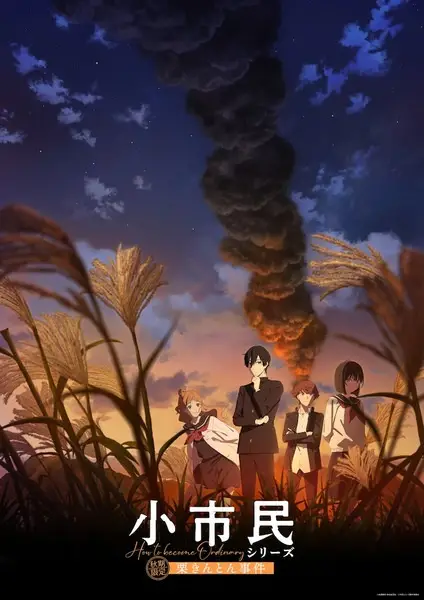
2025 spring | Episodes: 12 | Score: 8.1 (22015)
Updated every Sundays at 01:30 | Status: Finished Airing
Type: TV
Producers:TV Asahi | Movic | KlockWorx | Nagoya Broadcasting Network | AbemaTV | Bit grooove promotion | BS Asahi | TV Asahi Music | Anici | Tokyo Sogensha
Streaming: Crunchyroll | Ani-One Asia | Bahamut Anime Crazy
Synopsis
First-year student Takahiko Urino aspires to write something truly original for the school newspaper, Furnado Monthly. Encouraged by his girlfriend, Yuki Osanai—a seemingly average second-year student—Urino convinces the newspaper club to let him pursue an unusual story. A case of small-scale fires has escalated into serial arson, and Urino intends to predict the locations of future fires and identify the culprit. But his obsession with the case does not always reflect well on the club, and Osanai may not be so fond of her boyfriend's growing arrogance. Meanwhile, another supposedly unexceptional student, Jougorou Kobato, spends uneventful days with his girlfriend, Tokiko Nakamaru. However, when he witnesses a fire tied to a past case and Osanai herself, Kobato cannot help but slip back into his old, less-than-ordinary habits in search of the truth. [Written by MAL Rewrite]
Voice Actors

Umeda, Shuuichirou

Youmiya, Hina
News
![Spring 2025 Simulcast List [Update 4/7]](/_next/image?url=https%3A%2F%2Fcdn.myanimelist.net%2Fs%2Fcommon%2Fuploaded_files%2F1742946481-fa64b72da34bb9fed6518b56c1ec0087.jpeg%3Fs%3D1ccfbe06029b0f43d4e6cb0784fb1747&w=640&q=75)
03/25/2025, 04:48 PM
In this thread, you'll find a comprehensive list of television anime acquired for simulcast release during the Spring 2025 season. Anime series licensed for hom...

03/19/2025, 09:44 AM
In this thread, you'll find a comprehensive list of Spring 2025 titles with an accompanying promotional video, commercial, teaser, or trailer. This post will be...

09/14/2024, 10:00 AM
The tenth and final episode of Shoushimin Series (Shoshimin: How to Become Ordinary) ended with an announcement for a second season on Sunday, scheduled for a Spring...
Reviews

Leroiarivony02
The second season was one of the best anime I’ve seen this year. The story was solid, and the animation and soundtrack were impressive. It felt more refined and emotionally engaging than the first season. The art style fit the tone of the story well, and the characters were well-developed, with realistic reactions and growth. Overall, a strong 10/10 for me. I think many people would enjoy it, even if they’re not usually into this kind of series. The story of 2nd season is well-crafted and emotionally engaging. The art style fits the tone perfectly, enhancing the atmosphere without feeling overdone. Characters are well-rounded, with clearstrengths and flaws, and they react to situations in a realistic, relatable way. Even if it's not for everyone, many viewers will likely appreciate it for its strong character development, emotional depth, and high production quality.
patkarunungan
‘Shoushimin: How to become ordinary Season 2’ continues where Season 1 left off. At the beginning, Kobato and Osanai chose to go their separate ways because of what Osanai did in Season 1. § There are some changes that I liked and some changes that I dislike. §§ Season 1 was already great in terms of the use of the visual elements. It seems that a higher budget is poured into this season, leading someone casually looking at the visuals as better and more pleasing to the eyes. For example, Season 1's OP seems to resemble the quality of Makoto Shinkai's Your Name. In Season2's OP, it's a nice surprise to see the use of abstract images. §§ Speaking of the OP and ED, they’re good. They might not be one’s preferences in one’s musickal playlist, but they’re great as they are and only complement that craft poured into it by the staff. §§ A lot of people who dropped the first season would have been pleased with how Season 2 is structured. Instead of the episodic nature of the early episodes of Season 1, there's an overarching mystery per part, which probably reflects the novels being adapted. This makes it easier to binge-watch for people who are watching this anime after its air date, and for those who saw this anime as it aired, it gave them reason to look forward to the next episode. §§ I didn't like how its signature use of nondiegetick sequences seems to have disappeared or at least minimised. It turns out that much of it depends on Kobato's relationship with Osanai. This may not be apparent if you're not observing the visual elements, so this aspect may or may not affect your appreciation for this show. I'm just pointing out that it's there. §§ I prefer the cinematography in Season 1 despite the fact that, to the casual eye, Season 2 looks better. There are a lot of shots in Season 1 that are pregnant in meaning, such as how Osanai and Kobato are framed together or put as separate by a line motif. §§ Each part has a climax that represents the climax of a volume the anime covered. Each climax of the arc, or even if we take both of these climaxes together, doesn't exceed or even match the revelation of what Osanai had been pulling throughout Season 1. § My Judgement I'm giving this a rating of 8 out of 10. It's still a great show, but it doesn't hold a candle to the impact of Season 1 due to Osanai. NOTA BENE: A grade of 8 out of 10 means that I find this anime is very good and three notches above average. I enjoyed watching it. My enjoyment spectrum lies from 4 to 10. If I have scored an anime below 4, I actively dislike it.
NillyPC
If the first season of Shoushimin was like a calm breeze, this second season was a strong wind, bringing along a lot of great ideas and a continuation of a great, friendly cat-and-mouse game between Kobato and Osanai. This season felt like more of an exploration of Kobato and Osanai's strangeness in a world that isn't adjusted to such acts - all through the eyes of two seemingly ordinary people who become acquainted with the pair for a while. Honobu Yonezawa is a master at the feel of a mystery. The story really makes me want to stay within the investigating, clue searching, and contemplating thatOsanai and Kobato were doing. Paired with the subtle, but nice to hear soundtrack and it makes for an enjoyable experience. The art style continues to shine over and over again. It's so gorgeous and gives a lot of characters their own flair. Again, this is a must-watch for Hyouka enjoyers. It's the same feeling of chasing the mystery that made me really love Hyouka. It might feel a bit daunting - especially with how the first case functions - but I hope that by the end you can see what I've seen: a really great cat and mouse game between the oddest of people.
Yogiri_Takatou
The entire time feels like I am watching a MOVIE, it's my first time encountering an anime like this. The scene changes when they are talking or explaining something was new to my eyes. The characters are very well made and wonderful. After watching this I am now terrified of woman, especially one who's like Osanai, the cunningness, intelligence and the manipulations are so scary but the execution is quite good. I reccommend this anime if you want a slow paced but still makes your heart race. I was disappointed that they got separated in the earlier episodes but I'm glad, I finished the wholeanime. It took me one day to finish the remaining half of season 1 and season 2. Again, I am afraid of Osanai, how she manipulate is truly scary but I love her character.
silverszeta
"Why don't we go get some sweets to celebrate?" - Yuki Osanai the GOAT! Shoshimin : How To Become Ordinary Season 2 Continuation of season 1 about Yuki Osanai and Kobato Jogoro daily life to become Shoshimin Story : If you enjoyed the subtle charm of Shoshimin's first season, then you are pleased that this new season elevates the series significantly. The narrative embraces a more serious and intricate mystery, which brilliantly serves as a catalyst for Kobato and Osanai's growth. Their journey to become 'ordinary people' is more compelling than ever, with their relationship deepening organically through shared experiences. This season skillfully adapts two new cases, preservingthe unique Shoshimin atmosphere while offering sharper pacing and a meticulous attention to the nuances of every character's dialogue and actions. It's a truly rewarding watch for fans eager to see these characters develop. (9/10) Characters : I personally love the dynamics between Kobato and Osanai, about them helping and support each other in every cases. I would say that their dynamics become richer and emotionally deeper. Kobato is Holmes wannabe with his habit pry with others problem and loves solving mysteries. Osanai is the Moriarty female version, she continue her manipulative pulse and become more "evil" this season and i love that she is devious and sly like a wolf. She is scary tho. Side characters like Tokiko, Umino and Hisaka are essential for developing our mains to ordinary people but well they can't because Kobato and Osanai are not Shoshimin for now. (10/10) Music : Opening from Yorushika is PEAK musically and visually breathtaking. Suis voice and the instruments are so good and eargasm. Best Opening in Spring 2025 in my opinion. I can say same with ending song SugaRiddle by Yanagi Nagi, this song is so fun and they continue to mix the IRL footage with Osanai and Kobato there is such an amazing touch. (10/10) Animation : I can say Shoshimin art and animation is aesthetic and such nice treatment for my eyes. The animation can capture the vibes of any scene occured in the anime. This is same level of enjoyment of Hibike Euphonium beauty in terms of visuals. (9.5/10) Shoshimin Season 2 is not just continuation of Season 1 of Osanai and Kobato solving mysteries in their small town but this season offers with its sharp writing, masterful storytelling, and cinematic tone, it elevates the seemingly mundane into something truly memorable. The series doesn’t rely on dramatic flair or loud twists. Instead, it leans into subtlety, letting its quiet tension and emotional undercurrents speak volumes. I am glad that i decided to watch this series and hopefully for more of Osanai and Kobato journey to become the real Shoshimin in University. They are really made each other!
Khaledkucci1
Shoushimin Series ( how to become Ordinary) One of the mysterious anime I have watched last 2 years or (last years). If we talk about Shoushimin Series 2nd Season, I can only say it's perfect, solid thoughts,good plotting story, good characters, good opening and ending song and also production. There's no any tiny problem or thing in second season. Last three months I have really enjoyed the story that His presentation in the second season of the arsonist and the hit-and-run incident was very well done, especially the story of “the arsonist.”Characters was developed about the style, way-of-thinking and change of character of some of. Kobato and Osanai is weirdest characters I've see in anime those days or the all of the time. The production plays a important role here. Until first episode of Season 1 and and last episode of Season 2, I really in love of a good art and animation of this anime. Their dialogues, the way they move from one place to another, and the explanation of what happened as it happened in reality and place is something very amazing. I learned a nice habit from both Kobato and Osanai. Kobato loves reading while Osani loves going out and drinking tea, sweets, and parfaits and things like that. And their way of thinking. I don't believe these two people are talking and telling me that they are trying to be normal people! This is a joke to me. Overall Good anime I have recommendation to watch it guys, claiming and enjoying the new idea the And the other details are very interesting. Rated it 8/10 and waiting, looking for the Season 3 if came. either I will losing my time reading the Novel. Good anime I say.
will-o-wave
The cases in this season really ramped up compared to the first one, and I'm not even complaining (not that I could even if I wanted to). I already really enjoyed Season 1 with its simpler mysteries. It kept me hooked, trying to piece things together myself. But Season 2 just blew me away to the point I couldn't stop watching. It felt like it just kept getting better and better, and now I want more and more of it. I also absolutely love the dynamic between Kobato and Osanai from Season 1. The way they talk to each other, it's like they could go onforever, and I'd never get tired of it. So when this season started with them going their separate ways, I was really just waiting for them to reconnect. With a new girl confessing to Kobato and a new guy trying to get close to Osanai, both of those side characters got their well-deserved reality check. The red-haired guy’s conclusion, in particular, was satisfying as hell. Obviously, someone who loves Osanai and Kobato being together would be happy to see the dating-related distractions come to an end no matter how much time was spent on those interactions. And yeah, it was quite a bit (I'm sorry if I sound like I'm speaking from a romcom addict's perspective). Anyway, this show’s mainly a mystery series, written by the same author as Hyouka (which you probably know if you're looking up Season 2 reviews). I thought I’d break down the mystery aspects into a few categories and give it a rating to help you get a better view of what makes this anime shine: So here's my attempt for a category-based evaluation of.. Shoshimin: How to Become Ordinary Season 2 Case Quality/Mystery (9/10): The season juggles between multiple layered mysteries (arson, hit-and-run, hidden pasts), all slowly revealing themselves with interconnected threads. The misdirection is very well done (such as framing, manipulation, cover-ups). The answers line up with prior clues and build tension fairly, avoiding major plot holes in my opinion so the consistency is right there. Investigation Process (8.5/10): The show does a great job showing two contrasting styles of investigation in the first arc: Urino is enthusiastic and methodical, but a bit reckless, while Kobato is calm, calculating, and emotionally detached. What makes the process engaging is how both characters' investigations are shaped by their personalities, which adds layers to how the truth is uncovered. Rather than giving the audience clean clue-after-clue detective work, the series leans into how human biases and personal stakes influence the investigation. It’s not always about finding physical evidence, it’s about reading intentions and sometimes being wrong. That said, some reveals feel like they happen just after the fact, which means not all the deductions are completely visible to the viewer in real-time. But the emotional and psychological tension during the investigations keeps things gripping nonetheless. It’s less “classic detective work” and more about the consequences of trying to uncover the truth when emotions and pride get involved. Audience Participation (8/10): You’re encouraged to solve things alongside the characters. That said, some twists do come out of nowhere but in a good way. Characters & Suspects (9.5/10): My favourite part. If you love stories where even a casual line of dialogue can reveal someone's true colors, this show does that extremely well. Every character, major or minor, feels intentional and layered. Whether it’s the leads, their rivals, or even those who only appear briefly, the show makes you question everyone’s motives without making anyone feel like a caricature. Conversations carry tension, subtext, and sometimes subtle power plays that make every interaction worth paying attention to. Atmosphere (8.5/10): Maintains tension in both mystery and interpersonal dynamics. The setting usage like the newspaper club, train tracks, rooftop and hospital are symbolical and narratively relevant. Narrative Structure (8/10): Back-and-forth timeline helps build mystery in the hit-and-run arc. The slow burn benefits the end, though some might feel a drag early on. Emotional Impact (9/10): Osanai's sadism and Kobato's reflection hit hard. The "revenge through apathy" themes are chilling. Explores ideas of ordinariness, manipulation, romantic disillusionment and how pain shapes people. Ending (8.5/10): Both major arcs wrap up with satisfying conclusions. One in particular was well foreshadowed, and the emotional payoff lands. A couple of threads remain morally ambiguous, but that feels intentional. Overall, this series stands out just as much as Hyouka does, so if you enjoyed Season 1 or like character-driven mystery stories with a strong atmosphere, Season 2 absolutely delivers and even surpasses expectations. Visually, it's got great direction and cinematic shots, paired with a fitting OP/ED and good soundtracks that elevates both the tension and the quiet moments. This continuation is absolutely worth it. 8.625/10 ≈ 9/10
MarlsMarsBars
Shoshimin is one of those strange pieces of media where, by your own personal standards, this would just be a throwaway movie or show that you watch once, thought it was okay, but then forget about it a week later after it finishes. However, Shoshimin: How to Be Ordinary sticks with me. I really liked the first season of this anime, mainly because of how grounded yet intriguing this series could be. Most mystery anime are very over-the-top and grandiose in scale and flare, however Shoushimin keeps both the tone and atmosphere grounded in reality while also providing some insightful character work and drama. Season2 maintains this identity, however switches things up in terms of structure. Some of these changes worked for the best, while others left a little bit to be desired of. Most of the positives I had for last season are present this time around: the beautiful animation, grounded and cinematic direction, and most importantly, interesting plotlines with insightful character moments throughout. However for Season 2, Shoushimin switches from the shorter and more contained episodic adventures with two major arcs that are split between the twelve episodes of this season. The first arc with the mysterious fires is probably the best arc of this series, mainly due to the scale of the mystery this time around. This arc does a pretty good job drip-feeding clues and other exposition relating to the mystery, and was, for the most part, paced really well. The bait and switching worked the best in these episodes, and it left me not knowing where the story was headed after each episode. Leaving a viewer on the edge of their seat and going into the uncharted is what good mysteries do, and the first arc of Shoushimin Season 2 did not disappoint on that aspect. However, these episodes were not perfect. While the mystery that this arc revolves around was intriguing, we actually don’t follow the two main characters of this series in Jougarou Kobato and Yuki Osanai. For the first arc of Shoshimin Season 2, we follow the side characters that were teased at the end of last season. While the characters who took center stage in this arc were decently well-written, the biggest issue of this plotline has to be how little of Kobato and Osanai we saw until the final three or so episodes of this half of the season. While I don’t mind a change in focus for characters, Kobato and Osanai were the heart and soul of what made the mysteries interesting last season; whether it be their top-tier deduction skills, or insightful character drama that kept this anime fresh, the reduced screen time from these two was really felt when traversing the first half of this season. On top of this, Kobato and Osanai were separated until the last episode of this arc, which, in my opinion, dragged this season down just a little bit. I would have preferred if these two never split after Season 1 since the series never really found a way to make up for these two going their own ways. The side characters both Jougarou and Yuki hung out with were… fine. Takahiko Urino is who Osanai spends time with during this arc, and while Takahiko was basically the central character this storyline follows, his dynamic with Yuki Osanai was basically non-existent. To be honest, I can hardly recall when these two shared significant screen time together outside of the midseason finale. As for Kobato, he ends up with Tokiko Nakamaru, who is such a nothing burger of a character, I truly wonder why the author even bothered writing her in this narrative in the first place. Jougarou and Nakamaru have just as little screentime together as Yuki and Takahiko, however their breakup is so shallow and meaningless, it genuinely felt like a waste of screen time. Like I said before, I would have preferred if Kobato and Osanai stuck together throughout this arc, especially considering they end up together again once this arc ends and transitions to the next. As for the second arc of Shoshimin Season 2, it’s okay. This plotline focuses more on how Kobato and Osanai first met, and while the last few episodes of this arc were thrilling, this storyline was a lot more introspective with the two main characters. While this arc is less exciting than the last, there’s more character drama this time around, and I liked it. Although it is quite strange to end your series off with a character study, Shoushimin brings this all full circle with a really nice moment between the two leads of this anime. Overall, Shoshimin is a series that I’m going to miss. While some of the execution might be off, I overall enjoyed this anime and liked most of the changes made in this season. I want more mystery anime like this: slow and grounded mystery plotlines with unique and interesting character work. Of course, the animation and cinematic direction, along with other aspects like the soundtrack, make this an even more enjoyable show to watch, and also highlighting the fact that good animation and art direction doesn’t always exist in action anime only. I wish more non-action anime would take this form of directing style.
Rom-Com_lover
Comforting mysteries, subtle tension, and quiet heartbreak—Season 2 made me feel even more. This season was splendid! Absolute cinema✋😌🤚 Shoushimin Series Season 2 did way better than the first season. Every episode was mind-blowing. The mysteries felt more mysterious than ever, packed with twists you could scarcely imagine. Every single episode was layered with obfuscation, and I found myself glued to the screen. It required me to keep my mind active all the time to catch the nuances, and that's how a true mystery show should be. This season gave us more insight into Kobato and Osanai—the main characters of the story, yet ones we knew surprisinglylittle about. We got to see new sides of their personalities, along with more depth in their relationship and their past, balancing with mystery and thriller perfectly. Not to mention, the side characters also shined this season. The first arc focused almost entirely on a side character, and it was great to see the story from someone else’s perspective for a change. So overall, I have nothing negative to say about this show. Season 2 was a truly incredible experience. 10/10
MajiMaestro
Shoshimin is no mystery masterpiece, in the sense that it blows itself up to a wide-scoping scale with countless moving pieces akin to something like Apothecary Diaries. But what it does have is a much smaller and contained, personal form of mysteries, where the mystery itself serves to tell you more about the characters than the events that have transpired. Not to discredit the mysteries of course, the clues are planted expertly to be able to put together the answer before it's revealed, especially in this season where the mysteries stick to a bigger scale of two mystery arcs over it's 12 episodes. But in theend what kept me watching Shoshimin every week was the characters, in particular Kobato and Osanai. They're a truly magical duo to watch as they converse, share thoughts and by proxy of their owh overthinking selves, understand what the other is saying before they even say it. Others would, and definitely find it annoying, to hang out with someone like Kobato, that predicts what you say and want rather than to just ask you, or like Osanai, who says too little, expecting you to understand her intentions and feelings through the few things she does say. It's seeing these two intellectual, frankly pompous and definitely presumptuous extremes interact that makes Shoshimin so enthralling to watch, because they have a connection on the psychological level, an understanding and bond that somehow starts in the indescribable and slowly manifests into something else. And beyond the characters, the production value of this series is amazing, it all feels like watching an anime movie rather than a series. The lighting, the composition, the background and environments all have this vivid, detailed and "yeah, yeah that's what that store would look like" kinda feeling to it. Cafés and restaurants, libraries and hospitals, it's all presented so incredibly well for the scenes and context in the series. And I also must comment on the wardrobes, the characters in Shoshimin, especially Osanai, have TONS of different pieces of clothing and designs, it's wonderful! In the end, again, this is nothing that you can parade as the greatest thing mystery has ever seen, far from it. But Shoshimin makes itself truly unique through the main duo, and they make you stay for more until the final time you get to witness that wonderful opening and ending sequence.
MrKessler
One of the best shows of the last few years and I barely see anyone talk about it. Brilliant direction, rich and subtle character work, mysteries so well presented and crafted that make me watch the same episodes multiple times just so I'm sure I don't miss anything. You know a show is perfectly written and directed if it is able to keep you glued to the screen no matter how slow it is. Shoshimin does that in EVERY EPISODE. This show is a masterclass in how to deliver information without exposition: it uses shot composition, character acting and subtle dialogue to give you just theright amount of information that you can figure it out, but not too much so that you don't get surprised by the end. Season 2 manages to surpass even season 1 because it gives more time to each one of its mysteries, this time around, there are only 2, but each one of them builds up so well it makes the ending of each arc that much more satisfying. This season we also get a more thorough exploration of our main characters and their relationship. Which is essential for a second season, and Shoshimin just nails it. I can't praise this show enough, not giving it a 10 just yet because I need to sit with it a little more but for now its the highest 9 I can give
Enyirou
Oh mah gosh! As I mentioned last season, this time felt like a ticking time bomb. The last few episodes were thrilling, keeping you suspicious of one character only to surprise you with a twist. The fire incident was also shocking, especially with that unexpected ending, It had me thinking just like Urino! The characters are fantastic, especially Kobato, I love how he solves the cases. Honestly, Osama really doesn’t give Kobato a moment's peace! High school arc next???!? Season 3 please!!?’vnnvnv Overall mostly the same comments as last season, really enjoyed watching this at home usually at night, it really has that chill vibe atmosphere.The opening and closing song was fire.
5iv3_
Within the title, "Shoshimin: How To Become Ordinary", I feel this series really did its best to reinforce how our main leads are definitely NOT ordinary. Especially within this season, I felt it was highlighted VERY WELL how they differ from other people in different situations. With the introduction of 2 new characters, and their juxtaposed relationships with the 2 main leads, It really paints the picture that "oh, they're just crazy". How different they act, think, and navigate different obstacles. It really showcases just how different they are, and why they fit so well together. As a character driven show, it's by far oneof my absolute favorites now, with the storytelling coupled with the characters, it's such a wonderful bundle of mysteries. Also as always, Lapin Track delivers with the animation cause ITS SO PRETTY. genuinely also reminds me a bit of how shaft directs their shows too. also........*drum roll 🥁*......... This show has been crowned my Anime of the Season!! 👑🙌🙌🙌 this is my only 10/10 for the season so if that says anything, it's a wonderful show :)
XingLin
So I finally finished watching shoshimin and I gotta say, the series is really peak, as expected by the author of hyouka. The story is full of psychological thriller and the dynamic betweeen kobato jogoro and osanai yuki is quite extraordinary. The animation, despite being pretty simple, its more than enough for those that want to enjoy mystery shows like these. Not only that, I saw that the score went from 7.80 yesterday, to 8.02 after last episode, which shows how good and underrated the shoshimin series is. I personally rank this as top 3 of my favorite anime this season, 10/10.
FlowMAL
It's not often a second season surpasses the first, but Shoushimin Series pulls it off, and then some, raising the bar significantly. While Season 1 offered enjoyable yet ordinary everyday mysteries, Season 2 shifts gears into a full-on psychological suspense, delivering an experience that's both gripping and deeply satisfying. The slow-burn storytelling and detailed build-up of tension are executed incredibly well, especially during the second arc. I found myself completely locked in every episode, trying to piece together what on earth was going on. When everything finally clicked perfectly into place, it made the payoff all the more rewarding. Just like Season 1, this season has anincredible opening and ending, featuring great songs and captivating visuals. It's genuinely surprising how overlooked these gems have been. If you enjoyed the first season or simply love a compelling mystery, don't miss out on this. Shoushimin Series Season 2 is a bold and successful follow-up that actually does something different and pulls it off.
ZNoteTaku
“Do you promise that your detectives shall well and truly detect the crimes presented to them using those wits which it may please you to bestow upon them and not placing reliance on nor making use of Divine Revelation, Feminine Intuition, Mumbo Jumbo, Jiggery-Pokery, Coincidence or Act of God?” ~The Detection Club Oath When the mystery novel was establishing its own inner circle of authoritative figures, there were several rules which the “masters” insisted upon. Knox’s Commandments, as they were so-called, have been clung to not necessarily as immutable absolutes, but rather as a true way to “play fair” with the reading audience, that it is infact plausible to always present the reader with the chance to solve the mystery by making the game itself adhere to clear standards that should not be infringed. Therein lies a particular kind of glamour for both the story and the audience, that the detective exists beyond any emotional matters other than the sheer fun or love of “the chase” or “the answer,” and that the reader can congratulate themselves on staying on-track with the author or outsmarting their friends who are reading along as well. In this construction, the mystery novel is the greatest ego test as a reader. The consequence, however intentional or unintentionally it might be, is that they are ironically free of any consequence. The fiction and the reading experience became so much about “solving the mystery” that the detective assumed a lofty place both in and over the narrative itself. They were so untouchable as both an intellectual figure and an actual person inhabiting the story. The ego is unchecked. To put it in other terms, the detective is involved, but only insofar as supreme judge in light of the facts. The Oath may have spoken about avoiding “Divine Revelation” and “Act of God,” but the detective as a figure was itself divine. Yonezawa Honobu clearly loves detection club mysteries, but if *Hyouka* was any indication, he is not nearly so concerned with the whodunit aspect. That’s not to say that it’s unimportant (each mystery both in it and *Shoushimin* does have an answer that follows “the rules”), but rather that it’s not the point. Yonezawa loves clawing through the actual DNA and structure of mysteries as a larger phenomenon, understanding their pieces, people, and how they do, do not, and perhaps most significantly, how they SHOULD interact. It’s not for an answer – it’s for a meaning. *Hyouka* positioned Oreki Houtarou as someone who learns that mysteries occupy the everyday, and however mundane they may be, it’s always worth looking for The Future before it becomes The Past. He optimistically moves from impersonal to personal. Involved. In that spirit, *Shoushimin* seasons one and two not only are more than worthy to stand alongside *Hyouka* as one of anime’s great mystery narratives, but I’d daresay that it’s perhaps an even grander display of Yonezawa’s dissection. In its ever-thicker and ever-thornier knotting, it doesn’t take long to get there. Caught within the aftermath of the kidnapping plot that closed season one, Osanai and Kobato have reached an impasse and gotten themselves involved with others, Urino and Tokiko respectively. Old habits die hard, as each aloof smile from Kobato or Swiss-clockmaker-precise dessert bite from Osanai so indicates. Fires break out, property gets destroyed, and Urino eyes an opportunity to investigate! And all the while, Tokiko tries having some kind of normal relationship with Kobato, but why the hell can’t he stop smiling or be even marginally upset? *Shoushimin* season one prided itself on its intensive insularity. Regardless of whatever was happening at any given moment, mystery or otherwise, almost everything concerned its two leads (and occasionally Dojima). With the two leads now apart, the world opens to aerate the closed room, and with it, we see the sense of just who these two people are in reference to others. They do not exist in a vacuum, divorced from the weight of their words and consequences. Characters get mad. One-sided displays of affection are nearly acted upon. There’s a candid phone call about how a friendship is probably ending when the night is over. *Shoushimin* season two cares about how the detective perceives themselves and their interactions with the universe as actual tangible objects and spaces. It says that if you’re a detective, you are involved simply by existing as a detective (and a human being before that), and like it or not, things are royally going to suck for at least one person—if not more—in the midst, whoever they are. Compared to the days of Knox’s Commandments, the detective is, and causes, a mess, facing consequences for their relentless pursuit of the truth. You found the truth, but what actually happens here? Mysteries have never looked so glamourous with such deliberate lack of glamour. Being a detective, by necessity, brings friction, which Yonezawa and director Kanbe Mamoru exploit to deliciously tizzying ends. The cast glimpse mysteries with the same kind of innate thrill, but the vibrations in the air chart perpendicular courses. Urino’s full-fledged and unapologetic charge to find the arsonist setting all those fires is stoking not only his own ego, but likewise burning many others he’s coming across. As Dojima says point blank in episode one, “You’re too quick to jump the gun.” And given how irked Urino is that the greenhouse fire is small-scale, he has to follow the trail in the hope that it validates his own effort and time sink. Shouldn’t EVERYONE want to get behind him, to stop such damages? And besides, it’s not as though the fires are his fault since he’s so unconnected. After all, he’s just the detective! But for all the supposed non-involvement of The Detectives™, *Shoushimin’s* visual language pointedly involves them with their detached constructions of reality. There is a certain kind of perverse pleasure in Gifu as a setting: it is physical and with the thickest of tight art direction but, paradoxically, empty. Its spaces, its denizens, and even its denizens’ memories are employed as tools to reconstruct the closed room reality of the mystery, the real world treated itself like toys. Brazenly theatre-driven blocking with abstraction and lighting staging (something that I readily confess an aesthetic weakness for), freezing reality, and observing horror from a distance with a kind of calmness and pristinity too weird to be normal. It is in this realm that *Shoushimin*, driven by Kanbe’s sheer confidence in its ideas and theming, claims its territory. So long as any of the characters feel some kind of detachment, they can be at home here. The time there is fleeting though, and eventually, you or somebody else will have to answer for all the tinkering you did there. In Kanbe’s hands, Yonezawa’s story splays everything in both the macro and the micro, allowing its slew of mysteries and detectives to chart their courses and dirty the sandbox. The fate of Tokiko and Kobato’s relationship may not have the same gravitas as fires sprouting everywhere and the eager beaver gumshoe springing into action, or an incident that happened several years ago seemingly repeating itself. But wherever there is a mystery, there is someone trying to solve it, and it’s only a matter of time before the world itself or its people get effected because of the detective. An arbiter or investigator of justice, ready to point the finger at “the answer,” must by necessity dirty themselves. A popular light novel series once said that the detective was already dead. *Shoushimin* says that the detective, or ANY detective for that matter, simply existing causes problems. Just don’t let one of those problems be messing with Osanai, okay?
Marinate1016
Shoshimin season 2 is a perfect example of why you have to watch shows all the way through before passing judgement. I was a huge fan of the first season and really liked the first half of this season as well. Then there’s a big turning point around episode 7 or so that wraps up the first big case of the season and I HATED it. To the point I sorta became totally disinterested in the show, but the last 2 episodes completely changed my opinion on this season. I can now confidently say it’s better than season 1 by a big margin. If youcan get through the at-times slow moving serial arson case, you’ll have one of the most satisfying conclusions to a season waiting on you. I mean my jaw was on the floor for the last two weeks with this one and now I am desperately awaiting an adaptation of the 6th volume. This is a must watch for any Hyouka fan or fans of well written stories with great dialogue and direction. Shoshimin doesn’t really feel like an anime, it has such a nice cinematic feel to it that transports you somewhere else and allows you to fully immerse yourself in the story. Not to be overly dramatic, but this really is “absolute cinema” My experience with this second season of Shoshimin was such a mixed bag until the final arc. I loved seeing Kobato and Osanai dating other people because I felt their relationship in the first season was very toxic and bordered on codependency. Additionally, with their mental.. issues(to say the least), I felt like them being around each other would only encourage their bad tendencies and that they wouldn’t grow as characters/people. Guess who was wrong? Well, half wrong anyway. This season is pretty much one big build up to the realization that Osanai and Kobato are perfect for each other. They’re both deeply messed up individuals with a plethora of undiagnosed mental conditions, but they just work together so well. They compliment each other perfectly and by the end of this season it’s apparent, there’s no other partner for either of them. If it seems like I’m focusing intently on our two leads’ relationship, that’s because I am. It’s the very core of this series and what makes every episode so special. Their chemistry is undeniable, the way they exchange subtle jibes and the snarky replies, the attention to detail the author put into this story is amazing and it helps you fall in love with these characters. There’s really two big cases in this season in contrast to last season where it felt like we had one every week or every other week. The first one, the serial arsonist case was enjoyable until the last third where I felt it started to drag. Could’ve done with it being an episode or two shorter. It ended up really just showing why our two leads belong together. The second, the hit and run incident is easily the best in the whole franchise. For the first time, the seemingly always in control Kobato and Osanai are genuinely stumped by a case and the twists at the end had me damn near jumping off my couch. I learned a lot about Osanai in particular during that arc that changed my perception of her, making the overall relationship and series even better. There’s so many subtle details and the sudden reveals.. just perfection. Production values have always been one of my favourite aspects of this show and something that sets it apart from other seasonal anime. The letterboxd ratio giving it that film look, the subdued colors, the down to earth voice acting performances that feel believable, character designs, scene composition and direction.. this is a masterclass. If you’re a film nerd like me, enjoy the whole creative process, you’ll really find a lot of things to praise in this series. I could gush on and on about the writing, characters and cinematic aspects of Shoushimin, but honestly if you’re reading a season 2 review, you probably already know what to expect from this show. It’s one of the best mystery anime and season 2 is even better than the first. A must watch for any mystery fan and a needed continuation for anyone who watched the first. It’s that simple. They might be completely unhinged, but Osanai and Kobato will always be iconic. Shoshimin season 2 gets 10 out of 10
KANLen09
Shoshimin: How to Become Ordinary, the 2nd Sweet Bite — The second bite is not so sweet now, eh? If I have anything better to say about how the novelist of Hyouka, Honobu Yonezawa, took his work and elevated it with the Shoshimin Series, over the course of the 2 seasons that we got for the past year, it is the literal definition of "a second bite at the cherry." An opportunity: a second chance to do something, especially if the first fails outright. If you're not impressed with how the series' nuance of sweet things comes into play back in Season 1 last Summer, Season2 changes things and takes it up ten notches, much for the better. This slightly longer 12-episode season has not one second of it that is mundane, if ever at all. With Season 2 adapting the later released novels of Volume 3 and 4's Shuki Gentei Kuri Kinton Jiken a.k.a The Case of the Autumn-time Limited-Edition Candied Chestnuts and Sweet Potatoes, as well as Volume 6's Toki Gentei Bonbon Chocolat Jiken a.k.a The Case of the Wintertime Limited-Edition Chocolate Bonbons, which essentially brings the anime up to date with the original source material. If you thought that Season 1 looked plenty fine with all of the warm, fuzzy feelings of mystery cases that are only limited to their surroundings, then Season 2 will be quite the whiplash, bringing another two more cases that will inevitably bring you for a wild ride, as the Shoushimin name of the series gets quite the "show, not tell" attitude of more nuanced storytelling that'll blindside you every step of the way. If anything, I appreciate Season 2 more because of how the seemingly "ordinary" cases have been given much oomph in story and structure, and this tightly run "train wreck" of a psychological thriller story has so many moving parts that it leaves essentially no space for error to be committed. In fact, while the "regularly ordinary" citizens of Yuki Osanai and Kobato Jogoro seem like the perfect couple for each other, being two sides of the same coin, it's not until the sequel that their misfit friendship is tested to the limit, with the new characters that come to make their spot in the ever-growing trend of sinister cases that always seem to never end with their clues, theories, and resolutions somehow being sideswiped all at the same time. Unique to Season 2 are the new characters of Takahiko Urino, Tokiko Nakamaru, and Yuto Hiya. Given Jogoro's time with the Newspaper Club's president, Kengo Dojima, and how Season 1 basically set up the premise of how they print newsworthy articles for their own school, only for seemingly minor inconveniences that would result in the ousting of Jogoro's only confidante (outside of Osanai herself), the addition of the trio adds even more layers to what is already the result of, or rather, the outcome of mankind's malice and intimidation. The addition of outsiders into the cases just opens up a new can of worms for the usual cases ranging from arson to murder, being given the element of unpredictability as to where the story beats from every critical point in time, right till the finality of the matter that WILL inevitably result in at least someone getting hurt, intentional or not. Of course, Osanai and Jogoro are more than just jigs in a somewhat never-ending puzzle to still try and figure out how "ordinary" they can become, where they've clearly known that they've gone beyond the point of no return, but with a sliver of hope that people can accept them for who they are, much less the "couple" who are thinking minds alike. And most certainly, the inclusion of the one always playing the act of "heroism", his good and best friend confidante, as well as the femme fatale, playing good hosts to the regular crew, being obstacles stopping them from achieving what is best for each other. Otherwise, pretty much everything about the sequel here remains the same, from the immense captivity from series director Mamoru Kanbe's outstanding directorialship to Lapin Track's cinematic hue of production that doesn't miss the series' overarching feelings that remain just the same as its prequel. The only difference is with the change of the OP/ED theme songs, and while going from Eve to Yorushika for the OP evokes much subtlety that the latter does better vocal-wise, the other half from Ammo to Nagi Yanagi feels the same, but something tells my gut that Ammo did it better. If you have been on the fence about the Shoshimin Series ever since the premiere debut last Summer, this is more than just a P.S.A. that Season 2 just does everything better, execution-wise. I find it even harder to believe that it took 15 years for the author himself to once again concoct another story from the difference in time comparing the Autumn-time and Wintertime cases, but believe me that these two cases will absolutely show you why this series is, once again, like Hyouka came out to be, another masterclass of writing from Honobu Yonezawa. A mystery show, for the Ordinary, by the Ordinary, but one that'll keep you on your feet towards the end.
Mcsuper
The first season of Shoshimin: How to become Ordinary was mundane and calming, but left me with a sense of curiosity at what was coming next. This second season departed from more of the slice of life elements, and went into a more full-fledged mystery anime. Maybe some would wonder why this series did not start with the more high tension mysteries to draw a bigger crowd in to watch it, but to that, I would say that this season only worked so well because of the slower elements of its predecessor, as well as the character building from that. Before the events of this season,we know that Jougorou and Yuki split up, and through the events of this season, we learn just how much they are attached at the hip. Everything that happens feels like it is a destined event to eventually get them back together, because, as “ordinary” as they are trying to be, they are drawn to mysteries, and cannot look away from them. To me, their relationship is one of the most interesting around, and when they work together on something, they are as formidable as can be in how sociopathic and cold they are. As for the mystery itself, it is a very intriguing way to go about it. Firstly, everything that happens in the story is important in some way, whether it is foreshadowing, character development, or just a seemingly random detail to something, which I really enjoyed. Secondly, when we watch a mystery anime or a mystery novel, especially ones that involve a culprit, one would want a definitive answer right? Yes, the anime provides the viewer with some, but that is not the focus of it. Who the culprit is does not matter in the grand scheme of things, but it is the process, the way the beholder sees the environments around him that is of greater importance. The way the anime is directed and framed makes it feel like you yourself are in the shot with the detective, and perhaps, YOU are the detective, and you’ll come up with an answer. The anime will give you some, but the answer that you came up with yourself could be just as valid, and some things you’ll just never know. It always leaves you curious. To compliment the already amazing storytelling, I was in awe with how the already great looking visual direction from the first season was elevated to even greater heights in the second season. If it was not already clear from the opening song visuals, the effort in the backgrounds made the mysteries as immersive as they could be, so much so it made it feel like each episode was only five minutes long. It makes a big difference when an anime commits to a visual style that works with the genre perfectly. The centerpiece to my liking for this anime would have to be the cute and cunning Yuki Osanai. What’s not to like about her? She loves sweets and is so passionate about them, and always teeters between being adorable and being the biggest menace you have ever seen, absolutely mauling poor boys like the wolf she is. It has been a joy to watch her little revenge tales unfold between both seasons of the anime. Also, by golly, her voice actress, Hina Youmiya, has been killing it recently with her voice acting performances. I do not think there could have been a better casting than her with Yuki. The relationship between the two main leads was also very endearing, and handled in a subtle but impactful way. As the mysteries, backstories, and the rest of the plot got told, Jougorou and Yuki’s relationship and developments, whether they were together or separate, slowly but surely blossomed into something quite special. In my review of the first season I began with this: “Shoshimin: How to Become Ordinary* is quite a curious title. With it being a mystery anime, even just its title leads me to question things. “Shoshimin”, is translated as the petite bourgeoisie, which refers to someone in the lower middle class. So indeed, that might be what constitutes an “ordinary person” in a financial sense. Who or what is trying to be ordinary though? The characters? The whole plot itself?” After watching this season, I still do not have a proper answer for this, but I do find it worthy of note that while both Jougorou and Yuki are always tangled in mysteries and cases, when they themselves are not the subjects of the case, they rarely influence the end result from the culprit. If by chance, they did however, they would never do it intentionally. Their detective prowesses are not foolproof, and that is what it means to be a normal person. Early on in the first season, it was said that “an ordinary person must never stand out. They must spend every day in peace and do everything possible to avoid anything that interferes with that.” Whether or not Jougorou and Yuki followed this motto, only they really know if they did. In the end, we as the viewer are merely the observer. I do like how questions are unanswered though, because it lets us stay curious. Overall, this season was a marked improvement to the first in terms of the tension, as it stepped outside the mundane mysteries from the first season. Every episode had me thoroughly immersed, and I grew to love the characters more and more, with the excellent dialogue and visual storytelling. As Yuki clearly motioned toward her sundae in episode ten, this was indeed “absolute cinema”.
 Animanga